

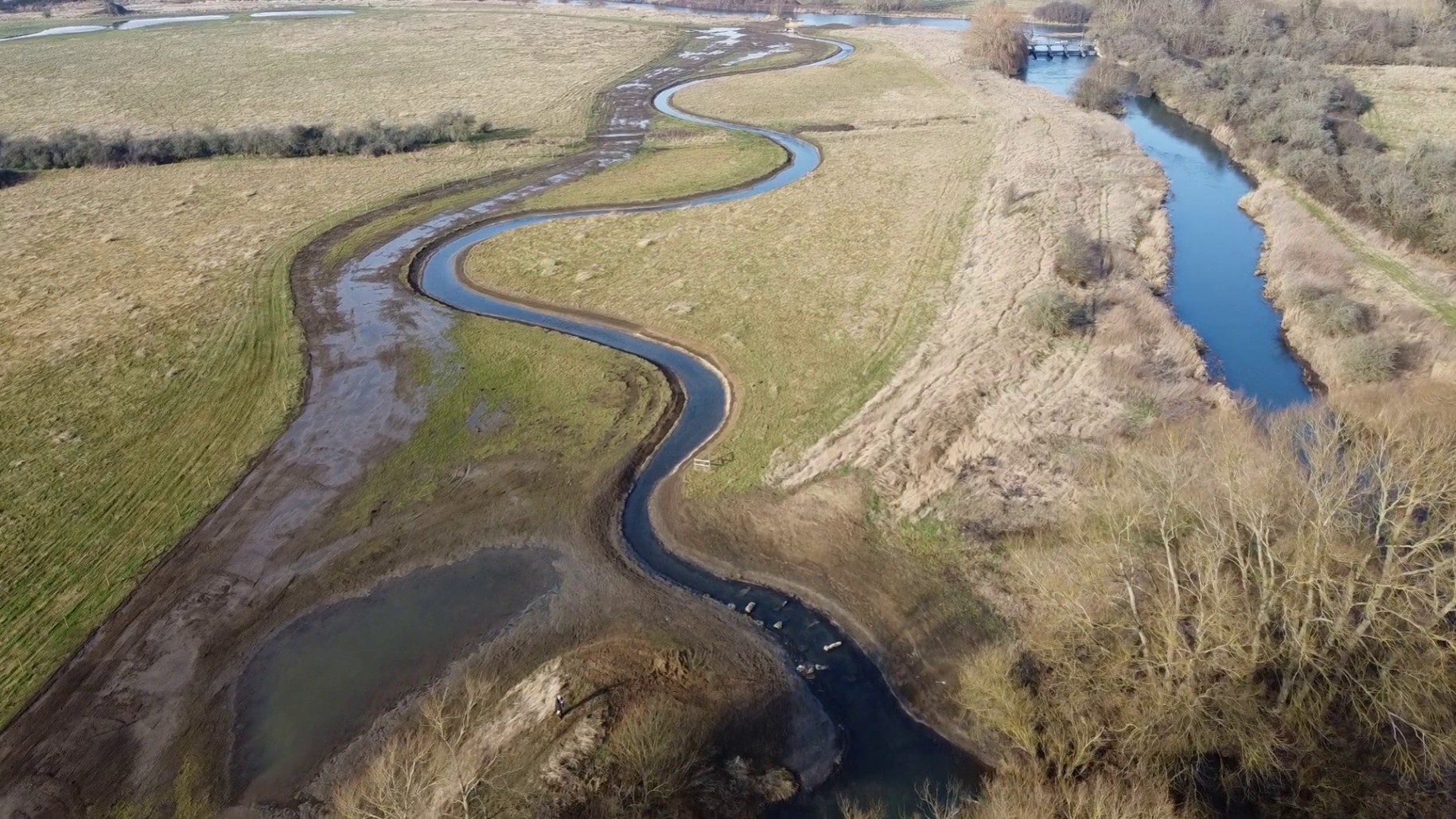
Swindon to Oxford (Sw~Ox) - Regenerating the Thames and Tributaries, is a nature recovery programme, run by a collaborative partnership of organisations, farmers, landowners, individuals and community groups, working together to improve the environment and create a sustainable rural economy through a variety of activities focussed on both nature and communities living in this landscape.
For centuries the River Thames and tributaries have shaped this lowland English landscape, where people have been intimately connected with their surrounding environment. This rural landscape, with waterways at its heart, winding between the urban centres of Swindon and Oxford, provides important habitats for wildfowl and wading birds, including internationally important breeding populations of curlew and lapwing, and represents an important corridor through central southern England for bats. Restored gravel pits in the Lower Windrush Valley, and small waters such as ponds and ditches, contain some of the best diversity of freshwater flora and fauna and are nationally important for wintering wildfowl, in particular gadwall and shoveler.
The region encompasses a National Nature Reserve, the Thames Path National Trail, Conservation Target Areas, SSSIs, Local Wildlife Sites and several country parks and areas of parkland including the National Trust’s Buscot and Coleshill Estates, plus many Areas of Potential Importance for Biodiversity, in the recently published Oxfordshire Local Nature Recovery Strategy.
However, as a result of relatively recent and ongoing social, economic and land use changes, the connection across the landscape has weakened and the habitats have become fragmented and disconnected. Together with significant water pollution and climate change, this threatens the ability of the river and floodplain to function as a healthy, resilient ecosystem.
Lowland meadow habitats (particularly the meadow burnet-meadow foxtail plant community) are at particularly severe risk, having declined by 97% nationally in the last century, and this region represents one of the last strongholds of this habitat type in the country. Aquatic habitats and threatened species such as curlew and the water vole are also increasingly vulnerable to pressures resulting from climate change and population growth, historic river modification and current pollution incidents.
Building on years of work in the area, in 2025, a group of stakeholders were brought together by BBOWT, National Trust and the Oxfordshire Local Nature Partnership (OLNP), to discuss collaborative working across the landscape and create a vision. There are a number of initiatives already successfully working in the region run by with community groups, volunteers, local surveyors and environmental organisations.
The partners want to take advantage of the brilliant work already going on in the landscape, and support the continuation and development of projects that deliver the programmes objectives and make them greater than the sum of their parts. The partners are now working on co-designing and delivering projects to sit under the Sw~Ox Programme that move us towards our vision.
The black poplar (Populus nigra betulifolia) has been identified by the Forestry Commission as the rarest hardwood tree in Britain with only around 7000 trees remaining.
The favoured habitat of the black poplar is wet (carr) woodland along lowland river valleys and floodplains. The Sw~Ox Black Poplar project will be working in partnership with various organisations and landowners with the aim to conserve and restore this rare native tree to this river catchment.
This area is prime for NFM in the tributaries upstream of Oxford, and several projects are ongoing. NT Buscot and Coleshill shared training and learning of their recent NFM project with the Upper Thames Farmer Cluster leading to further interventions in another sub-catchment. The programme partners intend to use the opportunity mapping carried out by the Windrush Catchment Partnership to scope and deliver further projects to maximise the impact across the landscape.
The water vole (Arvicola amphibius), a favourite character in the children’s classic The Wind in the Willows, has lost a staggering 95% of its range since 1900. American mink are an introduced predator that has decimated the water vole populations. The Sw~Ox partners will work collaboratively to expand the current mink trapping in the area carried out by BBOWT, training landowners in using equipment efficiently and joining up with regional efforts with the aim of eradicating American mink from our river system. Alongside this, we will continue to train volunteers to monitor water vole populations across the Sw~Ox landscape.
Berkshire, Buckinghamshire & Oxfordshire Wildlife Trust, Cotswolds Rivers Trust, Environment Agency, Long Mead Foundation, National Trust, North East Cotswold Farmer Cluster, Lower Windrush Valley project.



.png)